How Marijuana Saved My Life – V

Pro

There are many reasons why marijuana should be regulated and legalised.

Hemp

Hemp, the stalk of the Cannabis plant is what some would call a wonder crop. Right now it is illegal to grow hemp in many parts of the United States. Some States enable hemp licensing, however you need a permit from the DEA, which is not easily obtained. Some of hemp’s many uses are, to make extremely durable clothing, highly nutritious food and beverages, paper, rope, plastics, biofuel, building supplies and it can clean soil contamination.

Put in Context

A point raised in both debate above is that the drug policy in the United States and really the world is very inconsistent. Two of arguably the most harmful drugs in society today are tobacco and alcohol, which are both legal. Whereas drugs like marijuana and magic mushrooms are illegal and listed as Schedule 1 drugs.

Marijuana is the least addictive out of popular drugs. A 2013 documentary shows rates of dependence as: 9% of marijuana smokers become dependent; 23% of heroin users become dependent; 17% of cocaine users become dependent; and 15% of alcohol drinkers become dependent[i]. Also, unlike alcohol, you can’t overdose from marijuana. There are no known cases of overdose, and if someone did overdose, I’m certain one of the anti-legalisation agencies or the DEA would be all over it. I believe that the government should not regulate personal behaviour, we should be able to express our right to free will and liberty. If you do believe that the government should regulate personal behaviour, we should also make tobacco and alcohol illegal.
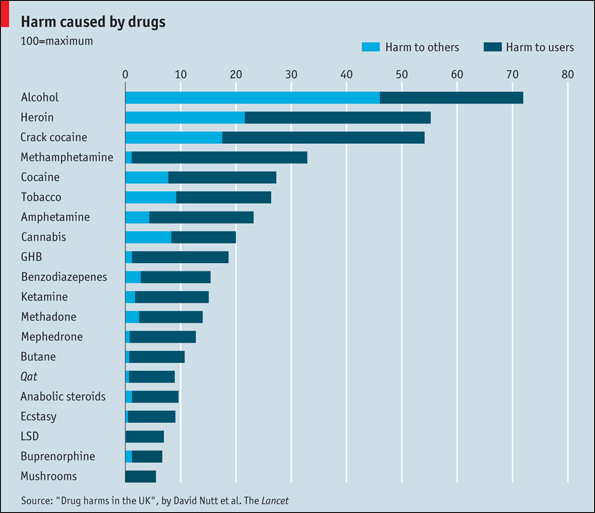
20101106_WOC504_0

Source: The Economist, “Scoring Drugs” http://www.economist.com/blogs/dailychart/2010/11/drugs_cause_most_harm

Safety

Legalising marijuana will make every aspect of the drug safer for everyone. Legalizing and regulating marijuana will help stop kids from using it. In its illegal state, kids can find a drug dealer somewhere, selling a variety of drugs, whereas, if it was legal their only option would be to visit a dispensary where they will be ID’d. One layer of restriction is better than nothing, particularly when some dealers prey on kids.

One of the most important reasons for legalising and regulating marijuana is the safety around the drug (this is also important for other drugs). Right now, 230 million people in the world are illegal drug users[ii] and for the most part they have no idea what they are putting into their bodies. In nearly every case with drugs, proper education and responsible use of drugs is relatively harmless but when anything could have been added to the drug, it’s a guessing game. A 2001 article from the Guardian that argues heroin should be legal (and is really worth a read) makes some really good points. During the prohibition of alcohol, bootleggers often times sold moonshine, moonshine can literally make you go blind and when produced poorly contained all kinds of poisons. This is not really an issue that we worry about today since alcohol is regulated and we trust the source. Heroin is so valuable that dealers will put in fillers such as paracetamol, drain cleaner, sand, sugar, starch, powdered milk, talcum powder, coffee, brick dust, cement dust, gravy powder, face powder or curry powder. Some of these are poisonous but none were ever intended to be in human veins[iii]. Similar associations can be made with marijuana and other drugs. Drug use won’t stop, but I think everyone could be helped by having access to safer / regulated drug production.

The Guardian article arguing for the legalisation of heroin also focuses on dirty needles and the harm caused by them. In the past, I have heard of clean needle programs, where clean needles are provided to addicts. I don’t think these programs are widespread though as one statistic shows that 33% of all aids cases in the US have been caused by the sharing of contaminated needles. The Center for Disease Control and Prevention shows that clean syringe access programs lower HIV incidences among users by 80%[iv]. Drugs should be legalised and regulated to make it safer for recreational users, safer for addicts and help stop kids from using them.

Society

A popular argument in the media these days is that legalising marijuana will generate substantial tax revenue (comparable to the levels of revenue generated from alcohol) for governments that are heavily indebted. I agree with this reason but I think it is quite ignorant to use it as the primary reason why marijuana should be legalised. Nevertheless on this same train of thought, legalising marijuana will also reduce costs of incarceration, costs of tying up the legal system to prosecute drug offenders, governments will save money on drug enforcement, police can focus on more important criminal activity and legalising marijuana will eliminate the criminal element; sending a huge blow to the Mexican cartels. Some of these changes have been seen from the effects of legalising marijuana in Colorado[v].

Here are some other statistics from the website DrugPolicy.org to illustrate the current social costs of drugs:

  • Amount spent annually on the war on drugs – more than $51 billion
  • Number of people arrested in the US in 2012 on non-violent drug charges – 1.55 million
  • Number of people arrested for marijuana law violation in 2012 – 749,825 (possession only 658,231 or 88%)
  • Number of people killed in Mexico’s drug war since 2006 – 70,000+
  • Number of students who have lost federal financial aid because of a drug conviction – 200,000+

These are staggering statistics, I’m not quite sure about the source of these statistics but most facts from this website are well supported. The website DrugPolicy.org’s bias seems to be wanting drug policy reform, but it seems to be more informative than anything else. Moving over to the additional facts section of the website there are quite a number of other drug facts and each fact is supported by a number of studies.

Here are the marijuana facts (there are some interesting facts on other drugs too, definitely worth checking out):

  • Most arrests are for simple possession with racial minorities over represented;
  • Most marijuana users don’t use other illicit drugs;
  • Increase in treatment admissions is nearly half based on individuals who aren’t characterised as being dependent (a third of people hadn’t used marijuana in 30 days);
  • Marijuana can be good for mental health; and
  • There is no link between car accidents and marijuana.

Addiction

After the death of Philip Seymour Hoffman, Russell Brand wrote an article for the Guardian that argues that the drug laws made Philip Seymour Hoffman’s death inevitable. As a former drug addict himself, Brand has a uniquely informed perspective on Hoffman’s addiction. Since reading the article I have become more familiar with Russell Brand’s stance on the legalisation debate and think his perspective is important to outline. Here are some excerpts from the article:

“Like a lot of drug addicts, probably most, who “go over”, Hoffman was alone when he died.”

“In spite of his life seeming superficially great, in spite of all the praise and accolades, in spite of all the loving friends and family, there is a predominant voice in the mind of an addict that supersedes all reason and that voice wants you dead. This voice is the unrelenting echo of an unfulfillable void.”

“Addition is a mental illness…which is hugely exacerbated by the laws that criminalise drug addicts.”

“If drugs are illegal people who use drugs are criminals.”

“People are going to use drugs; no self-respecting drug addict is even remotely deterred by prohibition. What prohibition achieves is an unregulated, criminal-controlled, sprawling, global mob-economy, where drug users, their families and society at large are all exposed to the worst conceivable version of this regrettably unavoidable problem.”

“Most importantly, (what) if we insisted as a society that what is required for people who suffer from this condition is an environment of support, tolerance and understanding.”[vi]

My interpretation of Brand’s message is rather than reject drug addicts as mentally ill criminals, what if we regard addiction almost like we do cancer and encourage an environment of love and support. This vision can’t happen when drugs are illegal, leaving the people that are addicted to fight their demons alone.

Medical

The research around the medical benefits of Cannabis are becoming more and more clear these days. Cannabis is seen to be able to treat those with chronic pain, Lupus, Chrones and Epilepsy. In the United States, 22 States have legalised medical marijuana and it is medically legal in a variety of countries throughout the world.

The first debate on marijuana that I referenced above features Dr. Sanjay Gupta. As I mentioned, Dr. Gupta released a documentary on medical marijuana last year (2013) and released a follow-up documentary this year (2014).

The documentaries are a very interesting expose into marijuana and its medical benefits. The first documentary features the story of 6 year old Charlotte Figi (a resident of Colorado State) who suffers from Dravet syndrome and at one point was having 300 violent seizures a week. Her parents had tried every treatment available, but nothing was working and the seizures were impairing Charlotte’s development. It literally seemed that Charlotte would not be able to endure this lifestyle much longer.

Generally most marijuana is higher in THC than CBD, but the Figi’s had a group of local Colorado growers create a special strain of marijuana for them, that was high in CBD and low in THC. Upon treating Charlotte with this special strain of marijuana, it worked nearly immediately and Charlottle’s seizures dropped to 2 to 3 times per month[vii]. This is a life changing result.

The second documentary shows the struggles of people that don’t live in Colorado. It illustrates that many families with illnesses are travelling to Colorado to take advantage of the treatment there, but then can’t take their medicine back over State lines. The documentary shows one family moving, leaving their family and friends in New Jersey and heading to Colorado to take advantage of the treatment available. A strange fact in the documentary is that although marijuana is illegal in the US, the US government has a patent on cannabiniods[viii].

It seems apparent that marijuana has medical benefit to some people. The fact that medical marijuana is not legal across the globe is a tragedy. I think this further reinforces my distaste for those that are anti-legalisation and approach the topic in jest, this isn’t a joke and it effects the lives of a lot of people.

Personal

While learning about marijuana and other drugs as well, particularly Wikipedia stands out. There is not much, if any mention of the beneficial aspects of using the drug recreationally. Why are people actually using marijuana recreationally, no one seems to care about this and if it is addressed, it’s usually from the perspective that users smoke marijuana because they are addicts. Well the rough statistic I showed above said only 9% of marijuana users become dependent, so what about the other 91%? This is a huge oversight and I think there is a taboo in some aspects of society today around enjoying pleasure, which doesn’t stop the media and corporations from exploiting our primal instincts (selling fear and sex).

When most people think of marijuana, they think of someone who is quite relaxed, someone who is laughing a lot and generally pacified. These aren’t bad things. Many people have a beer, wine or cigarette to unwind/relax after a long day at work, why aren’t people allowed to smoke marijuana to get the same effect? A benefit I find of marijuana over alcohol, is that where alcohol is a depressant, marijuana can let you relax and after the high, you just revert back to your normal state of consciousness. It has a lot less of an impact than a hangover.

Dr. Gupta’s first documentary on weed explains what happens when someone smokes marijuana in terms that I understand. The effect of the high is that the pre-frontal cortex of the brain (the commanding part of your brain or the CEO) is pacified and it amplifies the messages from the other areas of your brain. The other areas being things such as creativity, love, sense of well being and happiness[ix]. This pacification of the frontal cortex is what gives you a different perspective on things.

When your frontal cortex is pacified I’d imagine it’s a strange feeling at first. The dominance of the frontal cortex likely varies from person to person. I’ve found that a variety of things can happen depending on your setting. If you are hanging out with friends, it might result in talking about things that are deep and meaningful, you might just put on some enjoyable music, you might watch something that is funny or play some games. Pacification of the frontal cortex gives time to the other regions of the brain and enhances all of these things.

If you are with your girlfriend or boyfriend, it could lead to similar enjoyable experiences and it also makes sex feel even better.

Since the frontal cortex is pacified you feel much less inhibited, not as much as alcohol, but less inhibited for sure.

Not to play down any of those experiences, because they are amazing. But, I’ve found that marijuana’s biggest impact on my life is a result of inner reflection. This can be done with someone else through a deep conversation or it could be done in your own mind.

Zen-Contrarian-

Some of the things I have reflected on are:

  • Contradictions in the World (will be explored through this and subsequent blog posts)
  • Confidence (Be free, dance, sing and ignore what other people would think)
  • Conditioning (Media using psychology and our current states of consciousness to reach us)
  • Life (important things, what do I want, what makes me happy)
  • Marijuana allows you a perspective outside the normal cycle and you are able to focus on what is really important in life. It allows you the time to reflect on the things that are important to you.

Contradictions

A good example of contradictions in the world is the US message through the second half of the 20th century regarding the Communist evil. Yet, the US government committed many evils itself during this time. In this instance, who is good and who is bad, is it just a perspective of the person’s bias giving you the information? I think finding contradictions fuels your thirst for knowledge and most importantly the truth.

Confidence

In my experience, the release of dopamine from smoking marijuana makes me feel really good. This allows you to be free and just do what you feel like doing. It also allows you to think about certain things that you may not be confident with and explore why.

Conditioning

We are very conditioned these days by the media and our surrounding environment, less conditioned than some periods in the past though. Some examples of our conditioning include things like, we should be afraid of everything, we should worship celebrities, external beauty is very important (i.e. people should strive to look a certain way to feel good), women are objects and real men have power. I won’t delve into this too much as it will be the subject of another post, but upon reflection, I’ve realised that I didn’t decide these things make me happy, I was conditioned to think they are important. Real things that make me happy are love, well being, learning and having fun.

By entering another state of consciousness, the psychoanalytic techniques used to condition us aren’t effective and it allows us to consider if these things are important to us.

Life

My perceptions on life and my goals for this blog are summed up nicely in the mission statement of the website High Existence:

“Compel you to follow your bliss and make a life (not a career); provide a medium for free thinking individuals to connect & discuss, question anything and everything that is considered ‘normal’; explore all aspects of the human condition; and promote the general spread of happiness.”[x]

The self-growth that can be realized by entering into an altered state is unlimited. I have found that my new perspective has a lot of similarities to Zen. Here is a quote on Zen from a blog post on the website:

“Zen practice involves questioning everything, because, after meditating and cultivating mindfulness for long enough, you start to realize that everything can be questioned.  It’s remarkable how much BS usually pervades the mind of the person modern society views as ‘normal’ or ‘well-adjusted’.”

This is a conclusion that you can also come to when using a drug like marijuana or a psychedelic. These drugs give you a different perspective on the world and then you start to see contradictions, so many contradictions in fact, that it leads you to question everything. The website High Existence also recognizes this parallel:

“While strict Zen ideology values the natural authenticity of meditation over psychedelic experience, these substances have been known to aid in the process of experiencing mindfulness and exploring the mind.  I only mention psychedelics here because, in time spent reading Zen philosophy, I’ve found many parallels with philosophers who’ve implemented psychedelics into the quest for enlightenment. Terence McKenna, a brilliant psychedelic philosopher, said this:

“We have been to the moon, we have charted the depths of the ocean and the heart of the atom, but we have a fear of looking inward to ourselves because we sense that is where all the contradictions flow together.””

From my experience using marijuana and in limited instances other drugs, they have opened my eyes. They have provided me with a different perspective on reality, but marijuana in particular allows me to unwind after a long stressful day and some time for inner reflection. I can’t overstate how powerful it is sometimes to quiet that CEO in your head, so that you can focus on other things, rather than stress about this, that or the other.

Conclusion

Marijuana and drugs have been used throughout human history and have also been the subject of persecution for many different reasons. In the 21st century, there are many reasons to legalise marijuana and few to keep it illegal. Some progress has been made, in that medical marijuana is available today in many US States and countries around the world. There has been recent progress in the legalisation of marijuana (Colorado and Washington State, as well as Uruguay), but there is still a lot of apprehension for change. The prohibitionists are embarrassed by their lack of success and the fact that legalisation is gaining progress; while grasping to their life’s work.

Hopefully, this blog post has provided you with some insight on the debate. I’ll leave you with two key points.

Legalising marijuana doesn’t mean that everyone should do it, that is a person’s choice and people should be free to choose. It is not for some but, do it or don’t do it, people shouldn’t be criminalised for doing it.

Lastly, and the underlying subject of my blog, is that regardless of if you don’t use psychoactive drugs, every enlightened source urges you to live in the now, focus on the things that make you happy and realise that everything else is just noise.

-Oldmate


[i]Gupta Documentary Part 1 – http://www.youtube.com/watch?v=hrVXRZY1_x0

[ii]Drug use map of the world – http://www.theguardian.com/news/datablog/interactive/2012/jul/02/drug-use-map-world; 2012 statistic from the World Drugs report

[iii]Heroin article – http://www.theguardian.com/politics/2001/jun/14/drugsandalcohol.socialsciences

[iv]War stats – http://www.drugpolicy.org/drug-war-statistics

[v]Article on Colorado – http://www.policymic.com/articles/83075/marijuana-legalization-is-a-multi-billion-dollar-revolution-that-s-sweeping-across-the-usa

[vi]Brand article – http://www.theguardian.com/commentisfree/2014/feb/06/russell-brand-philip-seymour-hoffman-drug-laws

[vii]Gupta Documentary Part 1 – http://www.youtube.com/watch?v=hrVXRZY1_x0

[viii]Gupta Documentary Part 2 – http://www.youtube.com/watch?v=tAFu-Ihwyzg

[ix]History Channel Documentary entitled The Stoned Ages, hosted by Dean Norris

[x]High Existence – http://www.highexistence.com/

How Marijuana Saved My Life – Part IV

Con[i][ii]

There are many reasons why people believe marijuana should remain illegal.

Much of my sourced content comes from a man named Robert DuPont and his response letter (from his IBH position) to a Global Commission report on drug policy. Another source used in my ‘con’ write-up is a response letter from Mr. Dupont and many DEA officials on the marijuana legalisation in Colorado and Washington State. Sticking with the idea of knowing people’s biases. Robert is a former DEA chief and now runs a consulting company that specialises in providing employee drug testing solutions. He was the first director of the National Institute of Drug Abuse and he was the second white house drug czar under Richard Nixon and Gerald Ford. Therefore, he should be a reputable source for anti-legalisation arguments. He is also the founding president of the IBH, and his personal stance is that marijuana is the most dangerous drug, while he has also come under scrutiny for having a financial stake in keeping marijuana illegal (his consulting work).

War is working

Many proponents of legalising marijuana say that the drug war isn’t working, but is the war working? Mr. DuPont believes that drug enforcement efforts are working and that legalising marijuana is a reckless, experimental approach. He says that the right strategy is a balanced approach which means a balance of supply reduction and demand reduction. This balanced approach includes prevention, intervention and treatment, which he contends has been successful in containing illegal drug use and limiting social costs.

He illustrates the success of the balanced approach through the long-term decreases in drug use. Based on a national survey, the percentage of persons aged 12 and older in the US who have used an illegal drug in the past 30 days decreased from 14.1% in 1979 to 8.7% in 2009. This statistic shouldn’t be used to support any argument, as a number of reasons could explain the change in drug use, such as the national survey numbers could easily be skewed, people may have lied, and the timing of use element leads to more variables.

Another statistic supporting his claims, is that the UN Office of Drug and Crime has seen a greater than 80% reduction in annual opioid use over the past century. I found this fact quite interesting because as we know from earlier, at the turn of the century opioid use was wide spread. I delved deeper into this statistic and as noted previously, the British opium trade into China was a huge business. In fact in 1880, India derived 14% of its national income from the Opium trade and when China took to its own cultivation, it accounted for nearly 14% of its national income by 1909. Opioid use in Asia in 1907/08 was 3.3% of the population; the world use was 1.5% of the population. In 2006, opioid use in Asia was 0.24% of the population and the world use was 0.25% of the population[iii]. There are countless differences between today and 1900, yet this global decrease of Opium use is one of the IBH’s key statistics.One of the main differences between the periods is the information access/ability that people have to educate themselves today and also at the turn of the century, opioids were big business and in many cases people didn’t know they were using them.

A bolded statement to support the current drug policy in the response to Colorado and Washington State legalising marijuana says:

Sound drug policy must be rooted in evidence-based science, not driven by special interest groups who are looking to profit at the expense of our nation’s public health and safety.”

This again is absolutely ridiculous, Mr. DuPont has no evidence behind his statements that the war on drugs is working, he is a member of at least one special interest group and he has been criticized for profiting from marijuana being illegal. Yet, this is a person who has had and arguably still has authority around drug policies.

war-on-drugs-onr

Message/Increase In Use

Another argument is that legalisation will send the wrong message to people and will lead to an increase in marijuana use.

The response report against the legalisation of marijuana in Colorado and Washington State uses as argument against legalisation, that the US was a first mover in an international multilateral treaty against drugs and that legalisation will set a bad example for other countries. It is safe to assume that this is how some politicians feel about the message that legalisation would send to the American people. Are there a lot of people that would be swayed one way or the other if the US government legalised drugs? What message are they sending if they legalise drugs? You could almost read into the report’s statement that it is more about embarrassment; the people behind this letter, their entire lives have been devoted to the idea that drugs are bad. If you legalise it now, it will make these people look foolish.

Mr. DuPont has stated that the impact of legalisation will make drugs more widely and cheaply available. This will lead to an increase in death rates based on the parallel to the rapid rise in death rates from non-medical use of prescription drugs (which are widely available). Robert’s reasoning is that the drug use population in the world is 4.8%, whereas alcohol use is 40% and tobacco is 30%. He states the rate of drug use is low because they are illegal and that if they were legal they’d have use rates similar to alcohol and tobacco. At the very least though, he recognises that the legalisation of a drug doesn’t mean that everyone will become a user, similar to how not everyone uses alcohol and tobacco[iv].

First off, people in search of drugs these days, seem to have no trouble in acquiring them, so it is a poor assumption to say that use rates will increase to the level of alcohol and tobacco. A strong example to the contrary is that when opioid use was at its peak in China, the use rate was only 3.3% and opioids are some of the most addictive drugs around. Also, using marijuana as the example for a moment, there are no known overdoses of marijuana, ever. How would death rates rise to a level parallel to that of prescription drugs? In the same response letter, Mr. DuPont outlines the negative effects of marijuana, which include: dependence, cognitive, medical, psychiatric, fertility, educational, employment, parenting, workplace and highway and safety. Those are a number of effects which I won’t go in to, but you can pick out a few (if not all) that are a bit of a stretch.

He closes off this argument by saying that the largest increase in drug use will be among teenagers, the disadvantaged, the unemployed, the struggling students and mentally ill. Yet, there is no basis to this statement[v].

Gateway / Cost to society

One of the arguments that has lead to where our drug laws are today is that marijuana is a gateway to harder drugs. This is a fact says Stephen Baldwin. What is the context of this comment, is it a gateway drug for everyone? That seems a bit hard to believe, so maybe just a few. In any case, the Drug Policy Alliance, says that this is not a fact, a statement which is supported by research evidence. Perhaps, it appears to be a gateway drug in cases with some people, but you could argue that it isn’t the marijuana driving these people to other drugs, that could just be a result of their personality.

Mr. Dupont (in the IBH response letter) raises that another key aspect of legalisation is there would be substantial social and economic costs to humanity, if marijuana were legalised. Again saying that the greatest impact of the changes would be felt by the helpless, innocent and naive. More specifically, if drugs were made legal the rates of use, abuse and dependence would increase along with unemployment, under-employment and health care costs. In this instance, these statements are supported by statistics.

The social cost of alcohol is $235 billion each year and tobacco is $193 billion each year (which is a combination of $96 billion in medical costs and $97 billion from lost productivity). The words ‘lost productivity’ caught my attention right away when I read this, but I’ll continue. The social cost of all illicit drugs combined is $193 billion per year (lost productivity accounts for $120 billion, punishment costs account for $61 billion and health costs $11.4 billion). The cost of lost productivity trumps punishment costs by a 2-to-1 factor and is substantial for both tobacco and illicit drugs. So, what is lost productivity? The Office of National Drug Control Policy (ONDCP) defines lost productivity as representing work in the labor market and in household production that was never performed, but could reasonably be expected to have been performed absent the impact of drug abuse. In other words, drugs should stay illegal otherwise we will have a substantial increase in lost productivity!!

The greatest share of productivity losses is from criminal activities being offenders who were prosecuted and others who pursued crime careers to pay for their drug use. Together, there was about a million people years of effort that could have and arguably would have been available to the economy, had these individuals not been involved in drug-crime. The other large portion of the productivity losses are drug related deaths from all causes which include, overdose, poisoning, homicide, HIV and Hepatitis. A small portion ($4 billion total of the $130 billion in this example) relates to lost productivity of the victims of crime and institutionalisation[vi].

The correlation of illicit drugs to legal drugs and the use of lost productivity costs puts in perspective the ridiculousness of Mr. DuPont’s statistics. In fact, many of the productivity costs outlined could be prevented by legalising drugs.

Mr. DuPont expands further on marijuana’s cost to society[vii]:

“Marijuana use commonly saps the users motivation and determination. The losses with marijuana are tied to caring about people and goals. Not all users experience this effect but many do leading to the conclusion that marijuana causes users to become “stupid and lazy”, terms readily accepted by people who have been heavy marijuana users once they have stopped use. Marijuana is also called the “careless” drug because it causes any users to care less about the things they cared a lot about before beginning using the drug.”

He continues:

“Marijuana significantly impacts our environment, school scores and drop-out rates, accident and vehicle fatality rates, employee productivity, healthcare and treatment costs, and the potential for escalation to further illicit drug use and addiction.”

It is important to remember that these are his personal opinions without supporting evidence which is the foundation of why marijuana is illegal around the globe. Yet, there are no facts to support any of the claims.

Addiction / bad for you

Another argument is that marijuana is addictive and it is bad for you. The response letter to the marijuana legalisation in Colorado States that THC level are now 13.7%, a substantial increase from the 1970’s. This increase in potency has lead to dramatic increases in admissions to the emergency room and to drug treatment programs. The letter contends that marijuana is addictive and is the number one addiction treatment for children and number two addiction treatment for adults. My perspective is that the THC levels of marijuana are a result of its illegal status, this argument seems counterproductive to the letters aim. People are being admitted to the emergency room for marijuana overdose? The dramatic increase in drug treatment programs for everyone is likely a result of punishment for possessing marijuana. Isn’t the baseless statistic that marijuana is the number one treatment addiction for children, not further evidence that the war on drugs has been a failure and that children have more access to it in its illegal state.

No medical research

The response letter to the marijuana legislation in Colorado State says that marijuana is not a medicine and that there is overwhelming consensus in the medical community that it is not a medicine. The letter says the FDA’s stance is that smoked marijuana has no medical value and there are many other more effective, better tested alternatives. This sounds absolutely ridiculous again, as we will see in the Pro section of the debate below, Dr. Sanjay Gupta’s documentaries have clarified that marijuana is a very useful medicine. It is also medically available in 22 States because of efficacy to help those with certain illnesses. Even back when the marijuana laws were first being passed in the US, Dr. Woodward contested that the drug has some value in the field of psychology/psychiatry.

Impact on youth development

This fact is not raised by any of the sources I have used for the anti-legalisation section, but from the various documentaries I have seen, it appears that there may be some evidence that marijuana could have a negative effect on the development of the young brain. There may well be concrete evidence to support this fact and I have nothing against raising legitimate harms of the drug. However, the people raising this issue aren’t those that are pushing against legalisation, since this is not a strong argument for those people. I believe it is very important though and reinforces the fact that legalisation and regulation require an age limit, in order to prevent use by minors. Currently, there are no guards against use by minors.

Psychosis

It is said that in rare instances, people have developed psychosis from marijuana use. Again I’m not sure about the legitimacy of this claim. It seems to be a larger risk for those using it in their youth. I believe the difficultly of the research is that one can’t be sure if someone already had psychosis issues and marijuana just brought it out.

A BBC reporter, Nikki Taylor has a show where in one episode she embarked on a journey to find out what marijuana was about. She is not an experienced marijuana user and decides to conduct her research at a pot cafe in Amsterdam. On her initial visit, the owner of the shop is quite helpful and informative. The owner recommends a marijuana strain for Nikki and says relax, have a coffee. The owner advises to have 2-3 puffs of the splif, wait for 7-10 minutes to see what happens and then take another 2 puffs and repeat. So, Nikki in her very scientific research ignores all of that and takes a total of 25 puffs of this spliff (which is made of weed and tobacco). What ensues after 10 minutes is that Nikki descents into a state of paranoia and thinks she is crazy.

The next day, she doesn’t take responsibility for misusing the drug and instead condemns it[viii]. At this point, I stopped watching the show. Why should I watch and listen to your documentary, when you not only don’t listen to simple instructions, but you demonize marijuana based on your poor judgment. Grow up Nikki Taylor.

I have a personal perspective on the different effects that marijuana may have. The high is a very foreign feeling, but it is just a change in perception. So, why is it tough for some people to handle their first time smoking? Well, the answer might be that it’s just such a shock out of their normal way of being and consciousness. Maybe they start panicking because they are so deeply invested in the “system” that has been created based on their normal state of consciousness. As Joe Rogan says, if pot does you in, it might just be that the marijuana got there first[ix].

I remember a particular example of watching someone so deep in the societal customs of life, that when they tried smoking in a comfortable environment with two good friends, they reacted like they were hyperventilating; asking why is my heart racing? Well that’s an effect of the drug potentially, but based on your thoughts, current activity and state of mind your heart races sometimes. Maybe try to relax and take a deep breath. Some people are just not suited for exploring other states of consciousness and that is completely fine. Education on drugs rather than taboo and baseless statistics is the best approach to ensure everyone is well informed if they are going to try a drug.

Conclusion

In conclusion, I think the only legitimate argument against the legalisation of marijuana is the potential effects on the young brain. This is in fact a reason to legalise the drug, as regulation would restrict youth use. One cannot help but think the crusaders against legalisation are either addressing the topic from their personal bias or trying to justify their legacy and life’s work. The IBH makes a statement which leads me to think there is some attempt at justification which says – “Surrendering to the modern drug epidemic is not consistent with the IBH’s mission.”[x]


[i]IBH response to Global Commission – – http://www.ibhinc.org/pdfs/IBHCommentaryonGlobalCommissionReport71211.pdf

[ii]DuPont and DEA response to Colorado and Washington State legalisation – http://reason.com/assets/db/13625253281147.pdf

[iii]UN Office of Drug and Crime report – http://www.unodc.org/documents/wdr/WDR_2008/WDR_2008_eng_web.pdf

[iv]IBH Letter – http://www.ibhinc.org/pdfs/IBHCommentaryonGlobalCommissionReport71211.pdf

[v]Ibid

[vi]ONDCP report – https://www.ncjrs.gov/ondcppubs/publications/pdf/economic_costs.pdf which details what lost productivity stands for

[vii]Robert DuPont’s blog – http://www.wfad.se/blogs/robert-dupont/1017-why-marijuana-is-the-most-dangerous-drug

[viii]Truth About Smoking Cannabis – http://www.youtube.com/watch?v=sLtHOiIpJyM

[ix] Joe Rogan on Breaking the Set – http://www.youtube.com/watch?v=U8JgSuaFh5M

[x]IBH Letter – http://www.ibhinc.org/pdfs/IBHCommentaryonGlobalCommissionReport71211.pdf

How Marijuana Saved My Life – Part III

Debate

Intro

Now that we have some understanding of the history of drugs, we can get into the debate on marijuana. As a basis to get some points for the pro-legalisation and anti-legalisation arguments, I’ve noted in tables below points from two ‘debates’ on CNN.

For any sources that I use in outlining the debate, I’m also going to comment on their bias because if it exists, it will help put the person’s perspective into context.

Regardless of what your opinion is on the marijuana debate or what happens in regards to legalization, everyone should educate themselves. In many cases, people’s opinions are formed either from the perspective of certain media outlets or based on taboo. We live in the internet age, so it is very easy to get informed and do some independent research.

A good example of this in the media, is Dr. Sanjay Gupta, CNN’s chief medical correspondent. Dr. Gupta has created two mini documentaries on the topic of medical marijuana for CNN, which are used in my write-up. However, Dr. Gupta also admits that he came to his conclusion on marijuana years ago by just accepting some opinions in the media and considering that it must be bad based on it being a Schedule 1 drug. Along with his mini-documentaries, he has publicly apologized for being wrong in his opinions on marijuana, as when he did his own independent research, it opened his eyes on the topic and completely changed his opinion. This is a doctor in the media, so it is equally important for him to do the research, but it just shows the power of mainstream opinion in neglecting what can be found through independent research.

Arguments

The first ‘debate’ on CNN was on the Piers Morgan show in 2013. In the debate, Piers and Dr. Gupta discuss/debate marijuana with Dr. Howard Samuel (who is the CEO of Hills Treatment Center). Hills Treatment Center is one of the leading residential substance abuse treatment centers in Los Angeles. From the debate their doesn’t seem to be any obvious bias for Piers Morgan and Dr. Gupta is speaking from the perspective of his medical research on medical marijuana. Dr. Samuel though would have a large bias as he is the CEO (head) of a treatment center. Marijuana is a high volume criminal offense in the US and a lot of the drug possession policy requires many offenders to enter rehab. His bias is that he thinks that addiction is a big issue, a serious disease and legalisation would likely significantly reduce the number of his patients (no more mandatory treatment convictions).

The debate starts at around 4:35 in the video.

Dr. Sanjay Gupta vs. Dr. Howard Samuel[i]
Piers Morgan/Dr. Gupta’s arguments Dr. Samuel’s arguments
  1. Marijuana is less harmful than alcohol and alcohol is legal, why is marijuana illegal?
  2. Accidental prescription overdose is a much bigger and deadly issue in the US than marijuana (which is illegal). Vicodin for example is much stronger than marijuana.
  3. If we are banning drugs, shouldn’t we ban the drugs alcohol and tobacco which are more widely used and abused than marijuana.
  4. In the context of drugs, marijuana is the least addictive and yet is illegal.
  1. People must also look at the other drugs, marijuana is a gateway to harder drug abuse.
  2. Legalizing marijuana will just provide another substance for the nation’s youth to abuse and numb their feelings.
  3. Addicts have intense emotional side effects.
  4. If it’s legalized we will have commercials promoting its use.

The main points that I took away from the debate are: that inconsistencies exist between legal and illegal drugs and the harm they cause. Marijuana is the least addictive out of the common recreational drugs and accidental prescription overdose is a much bigger issue. On the anti-legalization side, it’s a gateway drug, it will give people another drug to abuse, and addiction is a big issue. I’m going to leave out commercials because they aren’t a serious deterrent to legalising marijuana.

The next debate from 2009 involves Ron Paul a former presidential nominee and senator who is a libertarian. He believes that liberty and the constitution should be the main basis for government policy and that many of the ways the US government is currently run, not only violates personal liberties, but the constitution. Mr. Paul’s bias seems to be general common sense but also granting people their liberty. He debates on CNN with actor Stephen Baldwin who is anti-legalisation and a born again Christian minister. His bias (which he alludes to in the video) is that Christianity sees marijuana as immoral and prohibited since it’s a stimulant/drug. Also, before becoming a born again Christian, Mr. Baldwin was addicted to cocaine.

Ron Paul vs Stephen Baldwin[ii]
Ron Paul’s arguments Stephen Baldwin’s arguments
  1. It’s really a question of who should regulate danger. He doesn’t believe in the nanny State but, if it should be regulated, it should be the regulated by the State.
  2. We didn’t have laws on marijuana until 1937 and have unsuccessfully spent tons of money on policing it. He cites an example of DEA agents cracking down on a person with cancer who was arrested for using marijuana medically in California.
  3. Tobacco and alcohol are two very addictive drugs, if government should be regulating personal behaviour, then make it consistent.
  4. Alcohol prohibition created the Al Capone’s, there is violence today over drugs only because they are illegal. Cartels win the most by keeping drugs illegal.
  5. We don’t need to endorse the behaviour of using drugs, but it doesn’t mean they should be illegal.
  6. I don’t think I’ve ever heard of a driver being impaired for marijuana use.
  7. The laws are putting tons of people in prison and if you get 3 drug offenses then you are there for life. This is an unnecessary incarceration cost.
  8. The government won’t allow the growing of hemp but, it grew fields of it to support the WWII efforts.
  9. The best approach is to regulate marijuana at the State level (like alcohol) and through families and communities. The worst approach is to use a federal thug with a gun.
  10. In its illegal state, kids have more access to marijuana now.
  1. He has been in two marijuana based movies and therefore he knows about marijuana.
  2. He is coming from a faith based conservative opinion that marijuana is a gateway drug. He says this is a fact and he doesn’t care what anyone else says.
  3. He says there isn’t a lot of research on medical marijuana but people should try to use something else. If nothing else is available then marijuana is fine. It’s important to note that by 2009, 13 States had legalized medical marijuana and in 2010, 81% of American’s polled believed that medical marijuana should be legalized in the US.
  4. If marijuana is made legal, the number of impaired driving deaths will increase.
  5. After all of Ron Paul’s other points, Mr. Baldwin’s last big question in a large jest was – Do you think there are a lot of marijuana smokers that are Ron Paul supporters?

I want to try and avoid slamming someone in my blog posts but, seriously Stephen Baldwin, screw you dude, all of your points are absolutely ludicrous and you have this fucking big joke at the end. This is a serious fucking topic as hundreds of thousands of people each year are going to prison in the US and their lives are being ruined because of marijuana’s illegal status.

The main points from the debate are that again inconsistencies exist between legal and illegal drugs and the harm they cause. There are many benefits to the cultivation of hemp and kids have more access to pot when its illegal. Other points include, the government shouldn’t outlaw personal behaviour, keeping drugs illegal creates and benefits organized crime, and people are needlessly going to prison. On the anti-legalization side, again it’s the fact that marijuana is a gateway drug, you should avoid using it medically as there isn’t a lot of research and if marijuana is legal, the number of impaired driving deaths will increase.

I found that in both debates on the side of legalization, people are really looking to eliminate the aspects of crime, grant people their liberty and make drugs safer. Whereas on the anti-legalization side, people are trying to enforce that marijuana is this big immoral menace and people who use it are criminals. In the sections below, I go into detail on the pro and con arguments, taking points from multiple sources.


[i] Video Source – http://www.youtube.com/watch?v=86udSl5Kr3c

[ii] http://www.youtube.com/watch?v=BPuJQaIgJeg

How Marijuana Saved My Life – Part II

History of Marijuana[i][ii]

There is evidence of the inhalation of cannabis smoke that can be found as early as the 3rd millennium BC. Cannabis leaf fragments and seeds were found next to a 2500+ year old mummified shaman in China. There is also evidence of Cannabis consumption that has been found in Ancient Egypt. Cannabis is known to have been used by Ancient Hindus of India and Nepal, and Ancient Assyrians. Even pipes dug up from Shakespeare’s garden have traces of Cannabis.

Cannabis was first criminalized in countries around the world beginning in the early 20th century. More specifically, the first restrictions for sale of Cannabis came into effect in 1906. It was outlawed in a couple of countries beginning in the 1910’s and 1920’s.

Let’s delve deeper into the original laws on Cannabis in the US. Two US professors have put together a detailed history of the recreational use of marijuana in the US and the documentary Grass has some insightful facts. Back in 1900 there were far more people addicted to drugs (between 2% and 5% of the adult population). This is a result of the use of morphine in various legitimate medical operations and the Patent medicine industry. People would be given morphine throughout their entire hospital stay and then leave addicted to morphine. The US Civil War also saw extensive use of morphine, particularly in the battlefield operations of the North army. As previously noted, the Patent Medicine industry lead to the most addicted group to being rural living, middle-aged white women. In general, medical resources were scarce, so patent medicine salesmen visiting rural areas would have a significant impact on the life there. Many of the patent medicines turned out to be up to fifty percent morphine. Whatever ailed you, the medicine would work, so you’d get more. Thus, a big difference between drug addiction at the turn of the century and drug addiction today, is that in the past nearly all drug addiction was accidental.

After the creation of the FDA in 1906, the very first federal law to criminalize the non-medical use of drugs came in 1914 in the form of the Harrison Act. The Harrison Act applied to opium, morphine and its derivatives, and the derivatives of the coca leaf. The interesting part about the Act is that it was a tax act. The drafters on the floor of Congress stated they wanted the Act to regulate the medical use of these drugs and they wanted to criminalize the non-medical use of them. It was widely thought during these times that Congress did not have the power to impose these laws regulating a profession in the States or to pass a general criminal law. Thus to avoid opposition, they enacted into law the Harrison Tax Act.

There were two taxes: the first tax was paid by doctors, essentially a doctor would pay the tax and get a stamp that allowed them to prescribe the drug to patients (as long as the regulations were followed). The second tax for users required you to pay a large tax for every single non-medical exchange of these drugs. It was outrageous though to pay a large tax in exchange for something that was worth five dollars in large quantities, so people didn’t pay the tax. Those found with the drugs who hadn’t paid the tax were charged with tax evasion.

In 1937, the US passed the national marijuana prohibition in the form of the Marihuana Tax Act which prohibited the production of hemp, as well as cannabis. The reason that hemp was also outlawed is open to debate, with some scholars believing that certain people had interests in destroying the US hemp industry. Before jumping into the Marihuana Tax Act, it’s important to understand the laws at a State level because marijuana was first prohibited by some US States before 1937.

In the period between 1915 and 1937, 27 States had passed criminal laws against the use of marijuana. Why did these States have marijuana laws? Well, after going back into the records of those States and looking at the newspapers of the times, it was found that the 27 States could be divided into 3 explanations for their marijuana laws.

Rocky Mountain and South-Western States

The Rocky Mountain and south-western States had seen a substantial migration of Mexicans just after 1914. The Mexicans had come to this area in search of better economic conditions and they brought marijuana with them. The white population in these States knew nothing about marijuana (this is at a time when the white race considered themselves to be superior to others). Thus the States in this area passed a law against marijuana use to discriminate/punish the Mexicans. One proponent of the law in Texas is quoted on the Texas Senate floor as saying, “All Mexicans are crazy, and this stuff (referring to marijuana) is what makes them crazy.” A proponent of the law in Montana State is quoted as saying, “Give one of these Mexican beet field workers a couple of puffs on a marijuana cigarette and he thinks he is in the bullring at Barcelona.”

North-Eastern States

The north-eastern States is the second group that enacted a law on marijuana, but there wasn’t a large Mexican population in this area. The reasons for the law becomes clear though when looking at the newspapers of the times. Here are paraphrases from a 1919 New York Times editorial. “No one here in New York uses this drug marijuana. We have only heard of it from down in the Southwest but we’d better prohibit its use before it gets here. Otherwise, all the heroin and hard narcotics addicts cut off from their drug by the Harrison Tax Act and all the alcohol drinkers cut off from their drug by the 1919 prohibition will substitute this new and unknown drug marijuana for the drugs they use.”

Utah

These two reasons accounted for why 26 of the 27 States prohibited marijuana, the remaining state was the first State ever to enact a criminal law against the use of marijuana, Utah. Utah had a large Mormon influence and in 1910 at a meeting of the Mormon Church it was declared that polygamy was banned. As a result, a large number of Mormons moved to the northwest of Mexico to continue in the “traditional ways”. By 1914, the Mormon people and the religion hadn’t done very well in Mexico and so the Mormon’s moved back to Utah but they brought marijuana back with them. The Mormon church has always been opposed to the use of euphoriants of any kind. So, in 1915 at another Church meeting, the use of marijuana was decreed contrary to the Mormon religion and enacted as a criminal law (at this time in Utah, the legislature enacted every religious prohibition as law).

Now that we have that background, the first federal laws against marijuana were enacted in the 1937 Marihuana Tax Act. In order to pass a federal law in those days, Congress had to hold hearings which can last for a very long time. The national marijuana prohibition hearings though lasted only two hours in total.

There were three bodies of testimony at the hearings:

Government

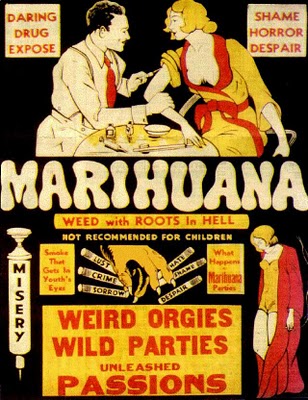
Commissioner Harry Anslinger, the new Commissioner of the Federal Bureau of Narcotics gave the first testimony. The FBI and the FBN were two newly created federal police agencies in the 20s and 30s. Harry Anslinger was the Commissioner of the FBN from 1930 until 1962. He was the first US drug czar (being the person who directs drug-control propaganda). He claimed that marijuana was the most dangerous drug, which was made famous in the 1936 movie Reefer Madness. In the movie, various crimes occur in the one hour film, from a hit and run killing, to manslaughter, suicide, attempted rape, and a general descent into madness. The movie Reefer Madness was part of Anslinger’s media campaign to raise public awareness about the marijuana menace in helping to get the 1937 Act passed. His approach was reliant on coverage by the media and supported by moralist groups.

In Anslinger’s testimony, he was reading a statement written for him by the District Attorney of New Orleans. He is quoted as saying, “Marihuana is an addictive drug which produces in its users insanity, criminality, and death.” This was the government testimony to support marijuana prohibition from the Commissioner.

images3NS6Y8TKDevil's_Harvestroots in Hell

Industry

The next testimonies were based on the idea of prohibiting the cultivation of Hemp in America. As I have noted, hemp can be used for a variety of purposes, so industrial spokesmen from each of the industries impacted testified. Of the spokespeople only the birdseed people balked, since apparently hemp seed made the birds grow lustrous coats and sing a lot. So, the birdseed people got an exemption from the Marijuana Tax Act.

Medical

The last hearing was medical and two people from the medical community were interviewed. The first guy was a pharmacologist at Temple University who claimed that he had injected the active ingredient in marihuana into the brains of 300 dogs, and two of those dogs had died. When asked by Congress, “Doctor, did you choose dogs for the similarity of their reactions to that of humans?” The answer of the pharmacologist was, “I wouldn’t know, I am not a dog psychologist.” Wow, poor dogs. Also, the active ingredient in marijuana was first synthesized in a laboratory in Holland after World War II. So, it remains a mystery as to was injected into the dogs, but it was almost certainly not the active ingredient in marijuana. The other testimony came from Dr. William Woodward who was both a lawyer and a doctor, appearing as the Chief counsel to the American Medical Association to testify on its behalf.

He is quoted as saying, “The American Medical Association knows of no evidence that marihuana is a dangerous drug.” Immediately upon saying this, one congressmen says “Doctor, if you can’t say something good about what we are trying to do, why don’t you go home?” The next congressman said “Doctor, if you haven’t got something better to say than that, we are sick of hearing you.” The committee had reason to be hostile with the doctor. In 1936, FDR had just been re-elected for his 2nd term in a massive landslide win, and the whole premise of the Democrat party during the election was around the social and economic reform legislation in the New Deal. From 1932 to 1937, the American Medical Association had been opposed to every single piece of New Deal legislation and congress was full of New Deal supporter, so they were sick of hearing from their opposing views.

I’ve read a good amount of the Dr. Woodward testimony and I recommend perusing it. I want to highlight two noteworthy pieces of information from it. During his testimony, Dr. Woodward notes that a prohibitive tax wouldn’t be beneficial as upon research marijuana may be found to have medical use and that evidence of research by one doctor showed that Cannabis had remarkable properties in revealing ones subconscious; hence it was useful for psychological and psychoanalytical research. The second being that Dr. Woodward draws attention to the fact that newspaper publications presented by the committee to support the new law included statements about marihuana causing crime and that school children are great users. Yet, none of these departments were called to testify and upon inquiry to the Bureau of Prisons, Children’s bureau and Office of Education, they all had no evidence of these situations. This shows the impact of Anslinger’s propaganda on the media and the media’s impact on society. The committee did not care if their facts were supported or if marijuana may have a medical benefit but instead just wanted the law to be passed.

The bill was passed out of the committee and on to the floor of Congress. The debate on the floor of Congress lasted around one minute and thirty-two seconds. The bill was brought on the floor of the house at 5:45pm on a Friday in August with no air-conditioning.

Before the vote, a guy from upstate New York, stood up and asked two questions, which constituted the entire debate on the national marijuana prohibition. 1) What is the bill about? Which the speaker replied to “I don’t know. It has something to do with a thing called marihuana. I think it’s a narcotic of some kind.” The guy from upstate New York then asked 2) Does the American Medical Association support this bill?

A guy who was on the committee that interviewed Dr. Woodward, and who later went on to become a Supreme Court Justice, stood up and said, “Their Doctor Wentworth came down here. They support this bill 100 percent.” The billed passed the vote and in the Senate there was no debate or recorded vote, thus the bill was signed into law by FDR.

Immediately after the passing of the Act, Commissioner Anslinger held a small news conference with most people who knew nothing about marijuana to name the psychologist from Temple University (the dog guy) the official expert of the FBN on marijuana which he held until 1962. For me, all of this is pretty mind-blowing stuff, it’s almost like some kind of sideshow.

During the 30’s and 40’s, marijuana was routinely referred to as “the killer drug” or the “assassin of the youth”. These ideas were continued to be put forth by Commissioner Anslinger as he was trying to build his FBN; more fear equally meant more funding to fight the menace. Marijuana got a worse reputation in the late 30’s and early 40’s for being used as an insanity plea in 5 famous murder trials. The two things you need for an insanity plea are an expert witness (which ended up being the pharmacologist from Temple University) and the testimony of the defense. The pharmacologist from Temple when on trial admitted to using marijuana which he says turned him into a bat. Then the defense would say it made them crazy when they used it. This defense worked in all 5 cases, in one case two police officers were killed in cold blood and the accused never even admitted to using marijuana. He said that it gave off ‘homicidal vibrations’ when it entered the room, so he started killing cats, dogs and ultimately police officers. Commissioner Anslinger pulled the plug on the official expert being allowed to testify as criminals were going free which stopped the insanity pleas but the taboo remained.

In 1951, the US enacted a new drug law called the Boggs Act. The perception at this time was that the drug was known to impact high school kids, it was deemed a foreign enemy and a communist tool to subvert the American youth. The linking of marijuana to a Communist plot continued through the period of Cold War hysteria. So, the penalties were quadrupled in every single offense category. The hearings were again held for the Boggs Act. A doctor of a rehabilitation clinic testified ahead of Anslinger. He testified that the medical community knew that marijuana wasn’t addictive, it doesn’t produce death, or insanity and instead of producing criminality, it likely produces passivity.

During Anslinger’s testimony, he now agreed with the doctor but said it is the certain first step on the road to heroin addiction. Anslinger’s statement, lead to the birth of the gateway drug notion and marijuana was grouped in with other harder drugs.

In 1956, another new drug law, the Daniels Act was put into place, the penalties around drugs were doubled again. In Virginia at the time, possession of drugs brought a mandatory minimum sentence of 20 years, first degree murder a mandatory minimum sentence of 15 years and rape 10 years. The sale of marijuana was a mandatory minimum of 40 years.

The 1960’s and 70’s saw the rise of drug counterculture in America, the Korean and Vietnam Wars were unpopular and the youth were seen as rebellious. There was a large uprising in the United States around the excessive prison time being given to the youth for using marijuana.

As a response, in 1969, the Dangerous Substance Act was passed and lowered the penalties removing the taxing methodology. This Act classified all illegal drugs into categories/schedules based on their potential for abuse and their medical value. Richard Nixon then commissioned a study to explore the effects of marijuana. The results of the study were that marijuana does not lead to crime. Nixon was outraged by the result and instead launched the War on Drugs in 1971 and in 1973, to fight this war he merged all of the drug enforcement agencies to create the DEA. Around the time the War on Drugs campaign was launched, marijuana had started to become popular with adults. This lead to the loosening of marijuana laws. In 1973, Oregon passed a bill to decriminalise marijuana. In a 1977 study, it was seen over the 4 year period (from 1973 to 1977) that there had been no increase in use. At this time, 10 other States along with Oregon had legalised marijuana.

Jimmy Carter won the 1977 election and had campaigned on the decriminalisation of marijuana. As president, Carter put forth a proposal to Congress to decriminalise marijuana and have it regulated by the States. Unfortunately, there was a drug scandal involving one of Carter’s aides, so he and the government could no longer support marijuana. The cost of the war on drugs from 1970-1977 was US$76 billion.

In 1980, Ronald Reagan campaigned on the message of cracking down on drug use. His vice president, George HW Bush succeeded him for the presidency in 1989 and came down even harder on drug users. He is paraphrased as saying in a public address, “Using drugs is against the law, if you use illicit drugs you will be punished; some think we won’t have room in prisons, we will make room; the rules have changed.” The cost of the war on drugs from 1980-1998 was US$214.7 billion[iii].

The results of the crackdown on drugs had such an impact that at one point in the late 90’s, 30% of a minority group male population (between 20 and 29) in Baltimore were under court supervision for drugs.


[i] http://www.druglibrary.org/schaffer/History/whiteb1.htm

[ii] Documentary entitled Grass, narrated by Woody Harrelson

[iii]Ibid


How Marijuana Saved My Life – Part I

Drugs have likely been around since before pre-historic man. They have been used throughout the evolution of human history in religion, ritual, global trade, medicine and recreation. The turn of the 20th century saw the first laws come into effect prohibiting drugs such as heroin, cocaine and marijuana. As we’ve progressed through the 20th century, drugs have become more and more villianized and the criminal punishments have become harsher. Entering the 21st century, things have started to change and the debate has been raging on whether marijuana should be legalised or remain a criminal offence. It has been debated countless times in the public eye and until recently nothing really changed. Then, Colorado and Washington State voted in 2013 to legalise the growing, sale and use of marijuana. Less known is that Uruguay became the first country to legalise marijuana (at the end of 2013). Marijuana vendors in Colorado opened up their doors in January 2014.

Should marijuana be legal or illegal? I believe that marijuana should be legalized because not only does the pro side of the marijuana debate far outweigh the con side but, an important part of the debate is being neglected from which I can honestly say that marijuana has saved my life.

What is marijuana?[i]

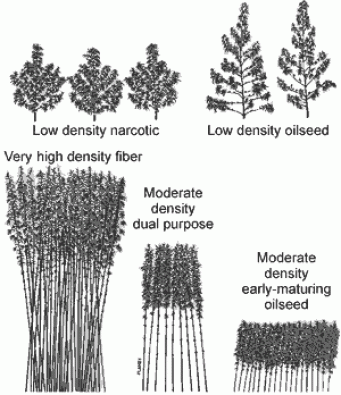
Let’s first get an understanding of what marijuana is. Marijuana comes from the flowers of the cannabis plant and consists of many cabaniods. The cabaniod that is most known for creating the plants psychoactive effects is called THC, whereas the cabaniod that is most commonly associated with health benefits is CBD. The cannabis plant is indigenous to Central and South Asia. The stalks and seeds of the cannabis plant can be cultivated into hemp which has a variety of uses and can be used as food, paper, plastic, rope and building material. Industrial hemp is very different from the cannabis used as marijuana, as it typically has an extremely low THC content. Here are some facts on hemp:

  • Hemp fibre is the longest, strongest, and most durable of all natural fibres;
  • Hemp cultivation requires no chemicals, herbicides or pesticides;
  • Hemp produces four times as much fibre per acre as pine trees; and
  • Hemp is easy to grow and actually conditions soil where it grows.

The picture below may help to illustrate some differences in the plant.

 marijuana plant

History of Drugs

In order to have an informed opinion on the marijuana debate and perspective on the laws today, I think it is important with every topic to explore the history of not just marijuana but drugs in general. Today in the United States drugs such as Cannabis, Mescaline, Peyote, Psilocybin mushrooms (magic mushrooms), Heroin, LSD and Opium are listed among others as Schedule 1 drugs. Schedule 1 drugs are defined as having a high potential for abuse and no currently accepted medical use in the United States. Clearly, there are inconsistencies in the classifications because neither alcohol nor tobacco fall into this category. The drugs in Schedule 2 are methamphetamine (crystal meth – which looks to have some serious side effects), Ritalin, Cocaine (which at high doses can cause sudden cardiac arrest), Morphine, Phencyclidine (PCP – which is considered by Wikipedia to be significantly more dangerous than other categories of hallucinogens) and Codeine among others. Schedule 2 drugs are defined as having a high potential for abuse, a currently accepted medical use in treatment and may lead to severe psychological or physical dependence. This shows further inconsistencies because some of the drugs in Schedule 2 have more severe side effects then some drugs in Schedule 1.

This is just a preview of what’s to come. I think it’s important to focus on this topic from a US perspective, as it is such as dominant and influential global force. Hence the policies of the US government have a large impact on basically everyone in the world.

Say-No-To-Drugs-Winners-Dont-Use-Drugs-Take-a-Bite-Out-Of-Crime

A lot of the information in this section was sourced from a History Channel documentary called the Stoned Ages (another good documentary is Grass which is narrated by Woody Harrelson). The documentary is hosted by Dean Norris and for those of you who don’t recognize the name or aren’t fans of the show Breaking Bad, Dean Norris plays Hank Schrader a DEA agent and the brother-in-law of Walter White. Having Dean host the documentary is a bit ironic as Dean plays a DEA agent in the show but in the documentary he takes you on an unbiased and informative journey through the history of drugs. At one point, he even interviews a DEA agent, but I digress. Pulling from the documentary and other sources below is a brief history on drugs.

Pre-Historic Man

Evidence of human interactions with drugs goes as far back as pre-historic man. We have found depictions of mushrooms on cave walls. Why paint mushrooms? Perhaps they were magic? There is also further evidence that prehistoric man may have used drugs, magic mushrooms in particular. This is supported by the Stoned Ape theory of evolution which says that drugs played an integral role in who we are today. The Stone Ape Theory was first introduced by Terrance McKenna and it states that around 100,000 BC foragers had to go in search of new food sources, one of which was psilocybe cubensis (magic mushrooms). The theory states that in low doses magic mushrooms improve visual acuity, making the foragers better hunters. He also attested that it would have prompted increased sexual arousal which would be evolutionary beneficial. It would also help dissolve boundaries promoting community bonding and would trigger activity in the language forming part of the brain. Terrance McKenna is an interesting guy; he became famous in the 1980’s for publicly speaking about drugs, particularly plant based psychedelics. I think this theory is definitely plausible as magic mushrooms may play a role in evolution today, since they can help you to think more clearly and can completely change your outlook on life. These effects can lead to a happier and healthier life.

Egypt and Ancient Maya

Frankincense and Mir were used to commune with the gods in Egypt and the Ancient Maya used hallucinogens in worship and ritual. The Ancient Maya actually considered the plants to be gods, so it was believed that you were putting the gods into your body.

Ancient Greece

The Greeks used magic mushrooms and Ergot (a fungi) in the rituals of the Eleusinian Mysteries. The Eleusinian Mysteries were common ritual in which people would use these drugs to meet the gods. Another example of drug use in Ancient Greece was when the Greek Senate would meet, the members of the Senate would be fumigated with incense to put them into a jovial state before discussing politics. This sounds like it would be an effective improvement on our politics today.

In an interview on a show called Breaking the Set, Joe Rogan discusses his opinion saying that psychedelic drugs likely are the origin of all religious experiences[ii]. This isn’t that farfetched as it seems that drugs have been used in religious ceremonies throughout history and in some cases psychedelic drugs are so powerful that people have claimed to see god. How easy would it have been thousands of years ago, to not know what crop you’re ingesting; it happens to be a psychedelic and you see god (thinking it was a miracle)?

Early Years of Christianity

The first ‘war on drugs’ was carried out by the Christians in the early 4th century. In the early years of Christianity, the Christians were generally antagonistic to other religions as their religion was growing. The Christians were suspicious of the pleasures of the body and felt threatened by people revering the drugs as gods, since there was only one god (which wasn’t a drug). This lead to the first war on drugs, which is best illustrated by the fact that Christian monks were known to burn down temples using drugs in their ceremonies and murder the people in the temple. Drugs use fizzled out in this period.

British Imperialism

Drugs came back at the height of British imperialism in the 1800’s with the growth of the global economy, through the British Opium trade. The British had access to large quantities of Opium from their colony in India and were flooding China with Opium. The trade became so large in scale and such a drain on Chinese society that it resulted in multiple Opium Wars (conflicts between China and Britain over the Opium trade). Britain prevailed in these conflicts and kept supplying Opium to China until such time that Opium also became an issue in Britain.

Patent Medicine Age

The next important age of drugs is the Patent medicine age in the late 19th and early 20th century. Patent medicine involved individuals coming up with drug formulations like cure-alls that typically included cocaine or opium. The patent on the concoctions allowed the owners to keep the ingredients a secret. The sale of Patent medicine was unregulated and had a significant adverse affect on the large population of users. This is quite similar to the illicit drug market today, in that you have no idea what is actually in the drugs.

What’s worse, was the unsuspecting victims using the Patent medicines were becoming addicted to them because the cures worked so well. The most effected group by Patent medicine’s were stay at home mothers. Also, around this time in the US, Bayer introduced Heroin into the patent medicine market and employees were being encouraged to take cocaine at work. This was effectively, the wild west.

Luckily, the Food and Drug Administration (FDA) was launched in 1906, requiring that all drugs be approved by the FDA before being sold to the general public. In 1914, laws were passed in the US which gave only doctors the ability to prescribe cocaine and heroin to their patients. This was followed by the national prohibition of alcohol in 1920. The alcohol prohibition was an utter failure though and with the onset of the Great Depression, the government was in need of money. So, in 1933, as part of Franklin Delano Roosevelt’s (FDR) New Deal the prohibition on alcohol ended.

In 1938, LSD was synthesized (primarily from Ergot) and was considered to be the most powerful substance known to man. It has the potential to create amazing times for the user or horrific times.

In the 1940’s, LSD was linked to therapeutic uses.

In the 1950’s, the CIA considered whether LSD could be used for mind control or chemical warfare.

In the 1960’s, it began being largely used for recreational purposes as a big part of the drug counterculture. Dr. Timothy Leary a centerfigure in the drug counterculture in the 1960’s is notorious for being named the most dangerous man in America by Richard Nixon. He was a psychologist and known for his advocacy of psychedelic drugs. He was arrested enough times to see 29 different prisons. Leary gives a good description of psychedelics in that they put you into yourself, you go on an inner journey of the mind.

In the 1970’s Richard Nixon was losing support for the Vietnam War and the growing drug counterculture had the government losing touch with the youth. Thus, in 1971, Richard Nixon declared an all out war on public enemy number one – drug abuse. In 1973, Nixon merged a number of federal department groups in forming the DEA to fight the war on drugs.

In the 1980’s, president Ronald Reagan carried on this war and prison expenses rose to the highest of all expenses in many States.

At this point in the History Channel Documentary, Dean takes a tour of a DEA holding facility with an agent. As you’ll remember, Schedule 1 drugs are seen to have no medical value and a high potential for abuse. The agent explains LSD, marijuana and Heroin were the big focus of the 70s which likely explains why they are in Schedule 1. Dean probes the DEA agent as to why marijuana is illegal while tobacco and alcohol are legal. His response is: don’t we have enough problems with alcohol and tobacco, but upon further probing states that we decided as a society to make these drugs legal. Well, saying we have enough problems with alcohol and tobacco isn’t a good reason to send people to jail or give them a criminal record for marijuana use. Also, as we will see below from the history of marijuana, the laws weren’t decided by society.

Today, America has 3% of the world’s population but 65% of the world’s illegal drug users. For some time, it was extremely taboo to say that you had smoked marijuana, but nowadays even some politicians are admitting that they’ve tried it before.

The most widely used psychoactive drug today is coffee. A statistic from 1999 shows that American’s consume an average of 3.5 cups daily. Moderate amounts of coffee can have positive health effects such decreased risk of heart disease, increased physical performance, increased memory attention and others. While excessive amounts of coffee for elderly individuals can cause very unpleasant and exceptionally even life threatening adverse-effects per PubMed.gov. Another common side effect is headaches. In the past and in certain religions, coffee consumption has been prohibited for its stimulate effects and I can definitely say that I have had some serious coffee highs. Coffee is so widely used because the effects of it are in line with society’s values of being productive.


[i] http://www.policymic.com/articles/83075/marijuana-legalization-is-a-multi-billion-dollar-revolution-that-s-sweeping-across-the-usa

[ii] Joe Rogan on Breaking the Set – http://www.youtube.com/watch?v=U8JgSuaFh5M