Drugs have likely been around since before pre-historic man. They have been used throughout the evolution of human history in religion, ritual, global trade, medicine and recreation. The turn of the 20th century saw the first laws come into effect prohibiting drugs such as heroin, cocaine and marijuana. As we’ve progressed through the 20th century, drugs have become more and more villianized and the criminal punishments have become harsher. Entering the 21st century, things have started to change and the debate has been raging on whether marijuana should be legalised or remain a criminal offence. It has been debated countless times in the public eye and until recently nothing really changed. Then, Colorado and Washington State voted in 2013 to legalise the growing, sale and use of marijuana. Less known is that Uruguay became the first country to legalise marijuana (at the end of 2013). Marijuana vendors in Colorado opened up their doors in January 2014.
Should marijuana be legal or illegal? I believe that marijuana should be legalized because not only does the pro side of the marijuana debate far outweigh the con side but, an important part of the debate is being neglected from which I can honestly say that marijuana has saved my life.
What is marijuana?[i]
Let’s first get an understanding of what marijuana is. Marijuana comes from the flowers of the cannabis plant and consists of many cabaniods. The cabaniod that is most known for creating the plants psychoactive effects is called THC, whereas the cabaniod that is most commonly associated with health benefits is CBD. The cannabis plant is indigenous to Central and South Asia. The stalks and seeds of the cannabis plant can be cultivated into hemp which has a variety of uses and can be used as food, paper, plastic, rope and building material. Industrial hemp is very different from the cannabis used as marijuana, as it typically has an extremely low THC content. Here are some facts on hemp:
- Hemp fibre is the longest, strongest, and most durable of all natural fibres;
- Hemp cultivation requires no chemicals, herbicides or pesticides;
- Hemp produces four times as much fibre per acre as pine trees; and
- Hemp is easy to grow and actually conditions soil where it grows.
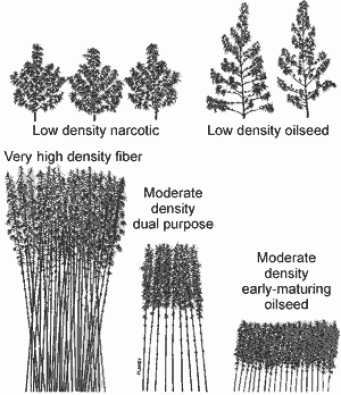
The picture below may help to illustrate some differences in the plant.
History of Drugs
In order to have an informed opinion on the marijuana debate and perspective on the laws today, I think it is important with every topic to explore the history of not just marijuana but drugs in general. Today in the United States drugs such as Cannabis, Mescaline, Peyote, Psilocybin mushrooms (magic mushrooms), Heroin, LSD and Opium are listed among others as Schedule 1 drugs. Schedule 1 drugs are defined as having a high potential for abuse and no currently accepted medical use in the United States. Clearly, there are inconsistencies in the classifications because neither alcohol nor tobacco fall into this category. The drugs in Schedule 2 are methamphetamine (crystal meth – which looks to have some serious side effects), Ritalin, Cocaine (which at high doses can cause sudden cardiac arrest), Morphine, Phencyclidine (PCP – which is considered by Wikipedia to be significantly more dangerous than other categories of hallucinogens) and Codeine among others. Schedule 2 drugs are defined as having a high potential for abuse, a currently accepted medical use in treatment and may lead to severe psychological or physical dependence. This shows further inconsistencies because some of the drugs in Schedule 2 have more severe side effects then some drugs in Schedule 1.
This is just a preview of what’s to come. I think it’s important to focus on this topic from a US perspective, as it is such as dominant and influential global force. Hence the policies of the US government have a large impact on basically everyone in the world.

A lot of the information in this section was sourced from a History Channel documentary called the Stoned Ages (another good documentary is Grass which is narrated by Woody Harrelson). The documentary is hosted by Dean Norris and for those of you who don’t recognize the name or aren’t fans of the show Breaking Bad, Dean Norris plays Hank Schrader a DEA agent and the brother-in-law of Walter White. Having Dean host the documentary is a bit ironic as Dean plays a DEA agent in the show but in the documentary he takes you on an unbiased and informative journey through the history of drugs. At one point, he even interviews a DEA agent, but I digress. Pulling from the documentary and other sources below is a brief history on drugs.
Pre-Historic Man
Evidence of human interactions with drugs goes as far back as pre-historic man. We have found depictions of mushrooms on cave walls. Why paint mushrooms? Perhaps they were magic? There is also further evidence that prehistoric man may have used drugs, magic mushrooms in particular. This is supported by the Stoned Ape theory of evolution which says that drugs played an integral role in who we are today. The Stone Ape Theory was first introduced by Terrance McKenna and it states that around 100,000 BC foragers had to go in search of new food sources, one of which was psilocybe cubensis (magic mushrooms). The theory states that in low doses magic mushrooms improve visual acuity, making the foragers better hunters. He also attested that it would have prompted increased sexual arousal which would be evolutionary beneficial. It would also help dissolve boundaries promoting community bonding and would trigger activity in the language forming part of the brain. Terrance McKenna is an interesting guy; he became famous in the 1980’s for publicly speaking about drugs, particularly plant based psychedelics. I think this theory is definitely plausible as magic mushrooms may play a role in evolution today, since they can help you to think more clearly and can completely change your outlook on life. These effects can lead to a happier and healthier life.
Egypt and Ancient Maya
Frankincense and Mir were used to commune with the gods in Egypt and the Ancient Maya used hallucinogens in worship and ritual. The Ancient Maya actually considered the plants to be gods, so it was believed that you were putting the gods into your body.
Ancient Greece
The Greeks used magic mushrooms and Ergot (a fungi) in the rituals of the Eleusinian Mysteries. The Eleusinian Mysteries were common ritual in which people would use these drugs to meet the gods. Another example of drug use in Ancient Greece was when the Greek Senate would meet, the members of the Senate would be fumigated with incense to put them into a jovial state before discussing politics. This sounds like it would be an effective improvement on our politics today.
In an interview on a show called Breaking the Set, Joe Rogan discusses his opinion saying that psychedelic drugs likely are the origin of all religious experiences[ii]. This isn’t that farfetched as it seems that drugs have been used in religious ceremonies throughout history and in some cases psychedelic drugs are so powerful that people have claimed to see god. How easy would it have been thousands of years ago, to not know what crop you’re ingesting; it happens to be a psychedelic and you see god (thinking it was a miracle)?
Early Years of Christianity
The first ‘war on drugs’ was carried out by the Christians in the early 4th century. In the early years of Christianity, the Christians were generally antagonistic to other religions as their religion was growing. The Christians were suspicious of the pleasures of the body and felt threatened by people revering the drugs as gods, since there was only one god (which wasn’t a drug). This lead to the first war on drugs, which is best illustrated by the fact that Christian monks were known to burn down temples using drugs in their ceremonies and murder the people in the temple. Drugs use fizzled out in this period.
British Imperialism
Drugs came back at the height of British imperialism in the 1800’s with the growth of the global economy, through the British Opium trade. The British had access to large quantities of Opium from their colony in India and were flooding China with Opium. The trade became so large in scale and such a drain on Chinese society that it resulted in multiple Opium Wars (conflicts between China and Britain over the Opium trade). Britain prevailed in these conflicts and kept supplying Opium to China until such time that Opium also became an issue in Britain.
Patent Medicine Age
The next important age of drugs is the Patent medicine age in the late 19th and early 20th century. Patent medicine involved individuals coming up with drug formulations like cure-alls that typically included cocaine or opium. The patent on the concoctions allowed the owners to keep the ingredients a secret. The sale of Patent medicine was unregulated and had a significant adverse affect on the large population of users. This is quite similar to the illicit drug market today, in that you have no idea what is actually in the drugs.
What’s worse, was the unsuspecting victims using the Patent medicines were becoming addicted to them because the cures worked so well. The most effected group by Patent medicine’s were stay at home mothers. Also, around this time in the US, Bayer introduced Heroin into the patent medicine market and employees were being encouraged to take cocaine at work. This was effectively, the wild west.
Luckily, the Food and Drug Administration (FDA) was launched in 1906, requiring that all drugs be approved by the FDA before being sold to the general public. In 1914, laws were passed in the US which gave only doctors the ability to prescribe cocaine and heroin to their patients. This was followed by the national prohibition of alcohol in 1920. The alcohol prohibition was an utter failure though and with the onset of the Great Depression, the government was in need of money. So, in 1933, as part of Franklin Delano Roosevelt’s (FDR) New Deal the prohibition on alcohol ended.
In 1938, LSD was synthesized (primarily from Ergot) and was considered to be the most powerful substance known to man. It has the potential to create amazing times for the user or horrific times.
In the 1940’s, LSD was linked to therapeutic uses.
In the 1950’s, the CIA considered whether LSD could be used for mind control or chemical warfare.
In the 1960’s, it began being largely used for recreational purposes as a big part of the drug counterculture. Dr. Timothy Leary a centerfigure in the drug counterculture in the 1960’s is notorious for being named the most dangerous man in America by Richard Nixon. He was a psychologist and known for his advocacy of psychedelic drugs. He was arrested enough times to see 29 different prisons. Leary gives a good description of psychedelics in that they put you into yourself, you go on an inner journey of the mind.
In the 1970’s Richard Nixon was losing support for the Vietnam War and the growing drug counterculture had the government losing touch with the youth. Thus, in 1971, Richard Nixon declared an all out war on public enemy number one – drug abuse. In 1973, Nixon merged a number of federal department groups in forming the DEA to fight the war on drugs.
In the 1980’s, president Ronald Reagan carried on this war and prison expenses rose to the highest of all expenses in many States.
At this point in the History Channel Documentary, Dean takes a tour of a DEA holding facility with an agent. As you’ll remember, Schedule 1 drugs are seen to have no medical value and a high potential for abuse. The agent explains LSD, marijuana and Heroin were the big focus of the 70s which likely explains why they are in Schedule 1. Dean probes the DEA agent as to why marijuana is illegal while tobacco and alcohol are legal. His response is: don’t we have enough problems with alcohol and tobacco, but upon further probing states that we decided as a society to make these drugs legal. Well, saying we have enough problems with alcohol and tobacco isn’t a good reason to send people to jail or give them a criminal record for marijuana use. Also, as we will see below from the history of marijuana, the laws weren’t decided by society.
Today, America has 3% of the world’s population but 65% of the world’s illegal drug users. For some time, it was extremely taboo to say that you had smoked marijuana, but nowadays even some politicians are admitting that they’ve tried it before.
The most widely used psychoactive drug today is coffee. A statistic from 1999 shows that American’s consume an average of 3.5 cups daily. Moderate amounts of coffee can have positive health effects such decreased risk of heart disease, increased physical performance, increased memory attention and others. While excessive amounts of coffee for elderly individuals can cause very unpleasant and exceptionally even life threatening adverse-effects per PubMed.gov. Another common side effect is headaches. In the past and in certain religions, coffee consumption has been prohibited for its stimulate effects and I can definitely say that I have had some serious coffee highs. Coffee is so widely used because the effects of it are in line with society’s values of being productive.
[ii] Joe Rogan on Breaking the Set – http://www.youtube.com/watch?v=U8JgSuaFh5M
 oldmatesblog